Chargement en cours


Written by
Lara Rojas
Personal trainer & nutrition coach in Geneva
FitsPro certified personal trainer, Les Mills instructor, Jeunesse & Sport and complementary therapist. More than 500 people coached in Geneva since 2018.
More about Lara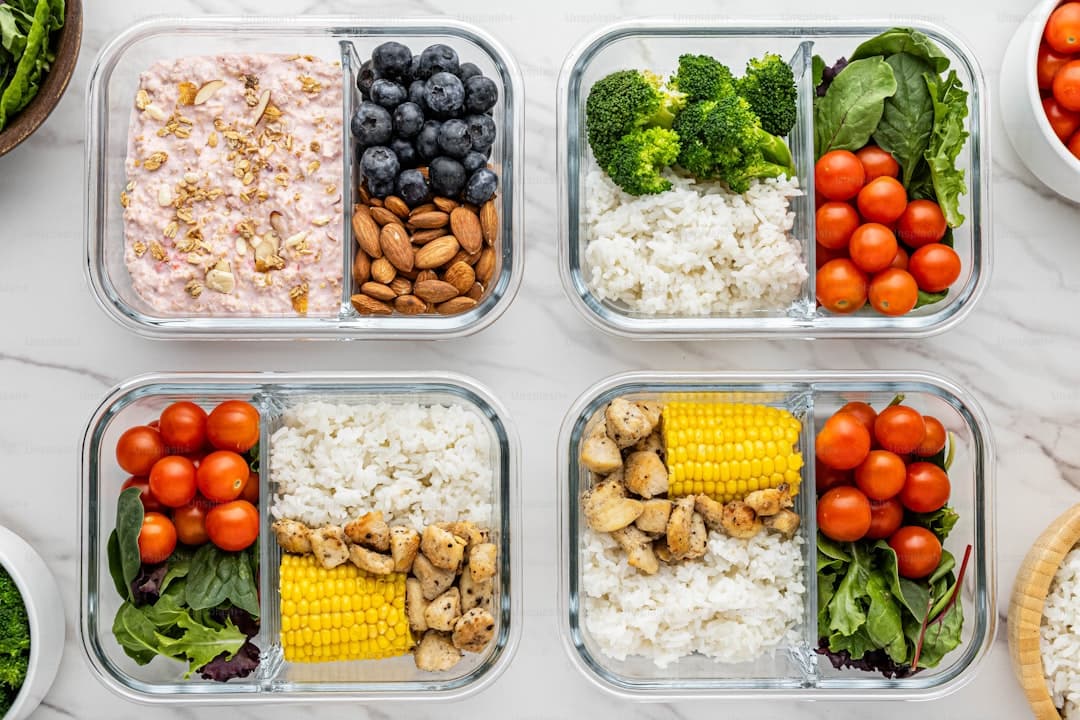
Meal prep is sold as a simple fix: two hours on Sunday and the week is handled. In reality, most people last one or two weeks, then stop.
The problem is almost never the cooking. It is how the preparation is designed: too many identical meals, no flexibility, and no idea of the quantities actually needed.
Five identical boxes prepared on Sunday are edible on Monday, bearable on Tuesday, and a punishment by Thursday. That fatigue is not a lack of discipline, it is a normal reaction to repetition.
The other failure mode is rigidity: one unplanned dinner, one meeting that runs late, and the whole plan collapses. A system that cannot survive a surprise is not a system.
Preparing healthy meals without knowing how much your body needs is working blind. Two people of the same weight with different activity levels do not have the same needs, and the gap is not trivial.
An estimate is enough to begin: the nutrition calculator gives a starting point based on your profile and activity level, to be adjusted from what you observe over a few weeks.
The simplest rule you can apply immediately: a protein source at every meal, vegetables for volume, and a carbohydrate portion scaled to the training you did that day.
This is the change that makes meal prep last. Instead of assembling five finished dishes, you prepare building blocks: one protein cooked in quantity, one or two starches, roasted vegetables, and a homemade sauce or dressing.
The same components become a bowl, a salad, a hot plate or a wrap filling depending on the day and your appetite. Variety comes from assembly, not from extra work on Sunday.
It also solves the surprise problem: if a meal gets skipped, the components stay usable, whereas a complete dish built for a specific day ends up in the bin.
The recipes on the site are built on this principle and adapt easily across several meals.
The order of operations is the difference between a two-hour session and a four-hour one. The principle: start everything that cooks unattended first, then fill the cooking time with the rest.
In practice: preheat the oven and load the vegetables and proteins that roast, get the starches going, and meanwhile wash, chop, make the sauces and get the containers out. Washing up happens as you go, never at the end.
A shopping list written before you leave avoids the second trip to the shop, which is the real time thief of any Sunday.
Cooked food should cool quickly before going into the fridge: leaving lukewarm preparations at room temperature for hours is the main source of unpleasant surprises.
Whatever will be eaten in the next few days goes in the fridge, in sealed containers. The rest goes straight into the freezer, portioned, rather than waiting in the fridge just in case.
Some foods do not keep well: dressed salads, breaded preparations and delicate fish are better made the same day. Sauces are stored separately.
Cost is the second reason people give up. Buying proteins and seasonal vegetables rather than processed products labelled fit changes the weekly budget without lowering quality.
The concrete pointers, shop by shop, are gathered in the fitness grocery guide for Geneva. And for meals eaten out, which are part of any realistic week, the restaurant guide gives the useful trade-offs.
A meal prep system settles within a few weeks: we start from what you already eat, adjust the quantities, then simplify until it holds without willpower.
If you want that plan built on your real needs rather than on an average, that is what nutrition coaching or a discovery call is for.
Discover my personalized coaching programs and reach your goals.
Discover coaching